Noilly Prattle

Thursday, August 13, 2015

Minami Sanriku

explosion and fire a Fukushima Daiichi nuclear plant
March 11, 2011 [Wikipedia]
        We decided to take a road trip to the deep north of Japan, the island of Hokkaido. We planned on a series of seven stops spaced out more or less evenly before boarding a ferry for Hakodate in Hokkaido. Our route took us through the Tohoku region in the northern part of the main island of Honshu. Many may remember that this area was hit by a massive earthquake and tsunami that destroyed many coastal communities on March 11, 2011, a little over four years ago. The same event also hit the nuclear power plant in Fukushima and caused a major catastrophe and meltdown of several reactors. The plant continues to leak radiation into the soil, groundwater and the Pacific Ocean. The plant is estimated to take some 40 years to cool down enough to close and bury the facility.


Matsushima
tsunami memorial
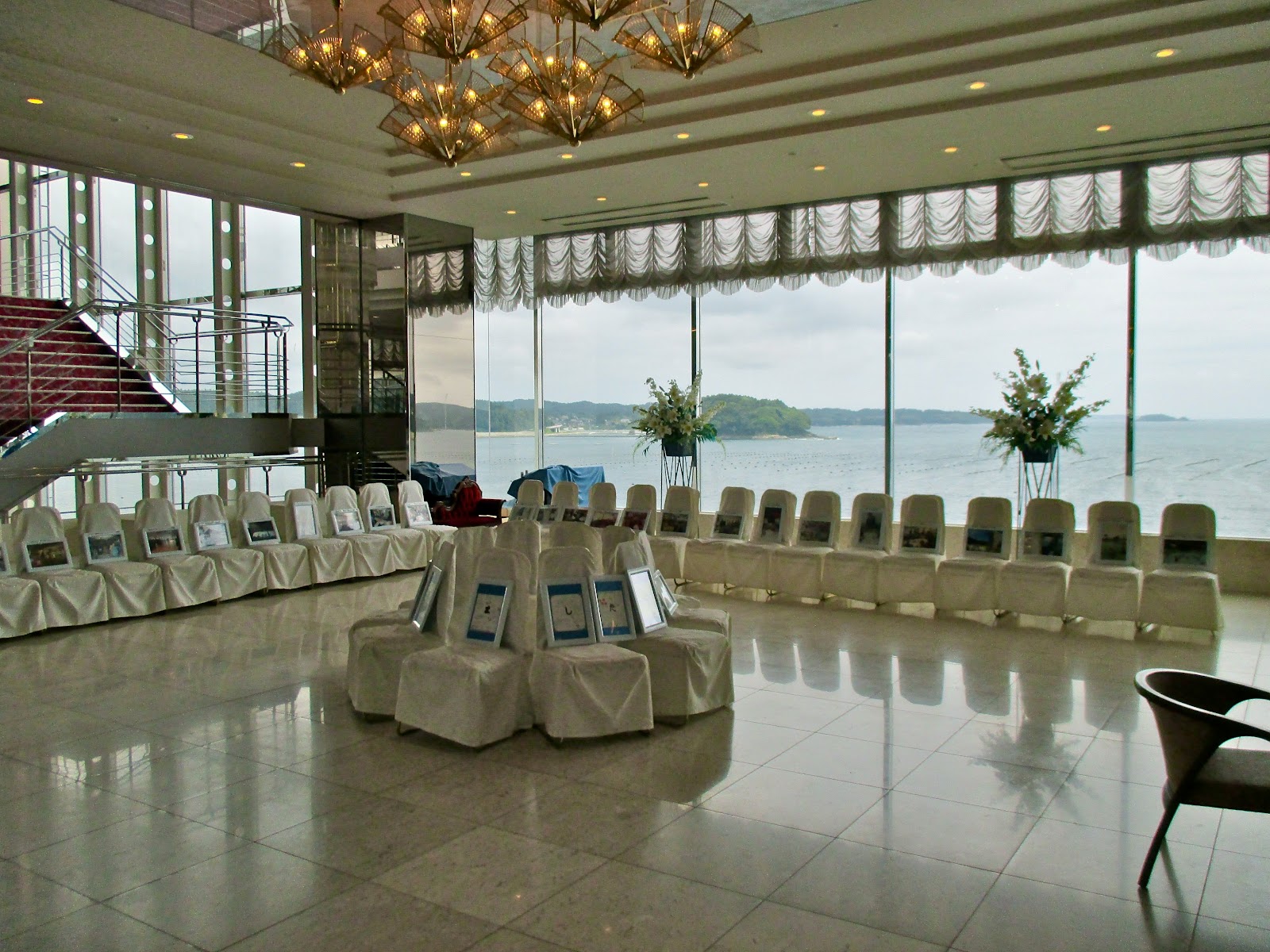
      One of Japan's famous natural beauty spots is the bay of Matsushima and we had planned to stop off there for one night. But then I remembered that the tsunami devastated town of Minami Sanriku was not far from Matsushima and I suggested staying there instead to see how the town looked after four years. It turned out that there was a hot spring hotel in the town (Minami Sanriku Kanyo Hotel) that had escaped most of the tsunami because of its elevated location. We learned while staying there that the hotel had served as a refugee center for many of the tsunami survivors from Minami Sanriku. There is a memorial room set up in lobby consisting of several white chairs with photographs taken during the crisis. Walking along and looking at the photographs is quite a moving experience. You can also get a very good view of the town from the huge hotel windows on the north end of the lobby. There is no longer a habitable town there, only large mounds of sand where people's homes and businesses used to be. 


what used to be the town of Minami Sanriku


Minami Sanriku Kanyo Hotel - post tsunami [Wikipedia]
sculpture made of debris from
Minami Sanriku tsunami strike


      After checking out of the hotel we drove around in the town. There is a lot of work going on that seems to consist mostly of building up huge sand dunes. There doesn't appear to be any rebuilding of homes of businesses. The only commercial activity we saw was a 7 Eleven convenience store and a makeshift gas station near a couple of the damaged buildings that are still standing. It is hard to imagine any kind of community thriving here for a long time if ever again.   

      I thought it would be interesting to compare some Wikipedia photographs taken during and after the tsunami with a few shots I took while driving around the construction areas. 
remarkable shot of the scene on the left as the
tsunami was surging into the town

Minami Sanriku before March 11,  2011


dazed survivors wandering through the ruins


The roof of this building was a designated safe haven, but it proved insufficiently high. Around ten people managed to cling to life there, but twenty others were swept away. 
the same building is still standing today
another damaged building still standing -
sign says Danger Keep Out


the immediate aftermath of the tsunami wave - said to have been as high as 20 meters (65 ft.)
they seem to be covering everything with mounds of sand


still removing debris after 4 years
trucks and heavy machinery everywhere


       These were the only signs of business activity we saw.


7 Eleven convenience store
Eneos gasoline pump


      And a poignant reminder of the inevitability of life even in the face of natural disasters.

man fishing in a stream that was once
30 ft. underwater - life goes on 


Tuesday, July 21, 2015

The Meandering Road to the Deep North

Matsuo Bashō
Bashō's best known haiku:
FURU IKE YA
KAWAZU TOBIKOMU
MIZU NO OTO
an old pond-
a frog jumps in-
the splash of water
     For 265 years the Edo Period (1603-1868) brought stability to Japan and effectively cut off the country from most foreign contact. It was a period of flowering in the arts: painting, wood block print, theater, music and dance, writing and poetry. The renowned haiku poet, Matsuo Bashō, lived in the earlier years of Edo (now Tokyo) and in 1689, some five years before his death, undertook a journey of 150 days on foot with an apprentice student to the northern part of Honshu. He wrote a travel account of this trip in his (奥の細道) Oku no Hosomichi translated as the "The Narrow Road to the Deep North". In his opening remarks he gives us one of the finest definitions of the urge to travel that I have ever read.


The Narrow Road to the Deep North
Matsuo Bashō
     The months and days are the travelers of eternity. The years that come and go are also voyagers. Those who float away their lives on ships or who grow old leading horses are forever journeying, and their homes are wherever their travels take them. Many of the men of old died on the road, and I too for years past have been stirred by the sight of a solitary cloud drifting with the wind to ceaseless thoughts of roaming.

     Last year...when spring came and there was mist in the air, ... I seemed to be possessed by the spirits of wanderlust, and they all but deprived me of my senses. The guardian spirits of the road beckoned, and I could not settle down to work.


        Our upcoming trip to Hokkaido this summer is not, strictly speaking, a “getting reacquainted” with Japan getaway since neither Road Buddy nor myself have ever traveled to the “deep north” of Japan. For a number of complicated reasons we decided to buy a new car last June. We had been talking about taking a trip to Yunan Province in China this summer before deciding to buy the car, a Mazda Demio 1.3 liter, but changed our plan to a road trip to northern Japan to break in the car (and hopefully keep cool as well) instead. Yunan is being postponed until the winter of 2016.


        While in no way trying to emulate Bashō, our winding road will take us to some of the points that he visited during his journey to northern Honshu but we will part company with the poet after visiting the 12th Century Chūson-ji Temple in Hiraizumi. Whereas he turned west towards the Sea of Japan, we will proceed to the northern tip of Honshu and take a ferry to Hokkaido, the northernmost island of the Japanese archipelago.

Map - Our approximate route


Wednesday, July 15, 2015

CLANK, CLANK, CLANK.....

     That's the sound of the (Greek) can getting kicked down the road....or sold down the river.

       I had been cautiously optimistic of a potentially workable way out of the economic crisis, now disaster, in Greece, through a carefully planned and coordinated exit from the Eurozone. Given the hand offered by the growing Eurasian alliance in the form of a pipeline deal, with an advance of some 5 billion Euros, and an offer to join the BRICS New Development Bank, Greece could have parted with the Euro and possibly revived its failing economy with a new start with the vibrant growth to the East.

the fickle finger of fate
       Unfortunately, the Syriza government made no attempt to prepare for a “Grexit” from the Eurozone and naively thought it could come to terms with the austerity demands of the “Troika”. The Tsipras government merely sought to put lipstick on a pig when it should have taken the bull by the horns (apologies for all cliches, but I'm too disgusted to be inventive).

       So, whether or not the Greek parliament approves the deal that Tsipras was forced to chew and swallow, the Greeks and European Union are back to Square One, in an unsustainable and unstable political and economic madhouse. Do you hear the sound of requiem bells for Europe?


Wednesday, July 8, 2015

The West fiddles while …

... the Eurasian Union grows

     And another “new world order” is being born right under the not clueless yet seemingly congested noses of NATO. I refer to the Ufa summit in Russia being attended by the part of the planet that is not embroiled in senseless and useless wars—the SCO, the BRICS and the evolving Eurasian Union.


      I referred to the SCO (Shanghai Cooperation Organization) in a July, 2012 blog with the somewhat quixotically titled post IPI, TAPI, NATO, SCO . . . in which I imagined the planet dividing and coalescing into two competing empires that I labeled NATO and SCO—the former embroiled in endless conflicts the latter doing business (or playing while the cat's preoccupied).


       So, while the European Union is in meetings to either put out or throw gasoline on the flames of the Greek drama (only time will tell), the Eurasians are busy making business deals, adding countries to their ranks, building a new silk road trading empire and generally going on about doing business.