Noilly Prattle

Tuesday, July 11, 2017

China 2017: 18 – Dong Village, Chengyang

some blue sky--first time in several days
    We had an early breakfast which was included in the room rate at the hotel. After breakfast we threw a few things into our backpacks for an overnighter to a Dong Village. The Dong is the largest Ethnic Group in the Sanjiang region. They are closely related to the Miao people in our previous stop in Fenghuang. The Dong Village of Chengyang (18km north of Sanjiang) retains much of its traditional charm. It is especially known for the architecture of its a wooden covered bridges. According to the tourist brochures one of the bridges, the Wind-Rain Bridge, in one of the ”four best known bridges in the world”.


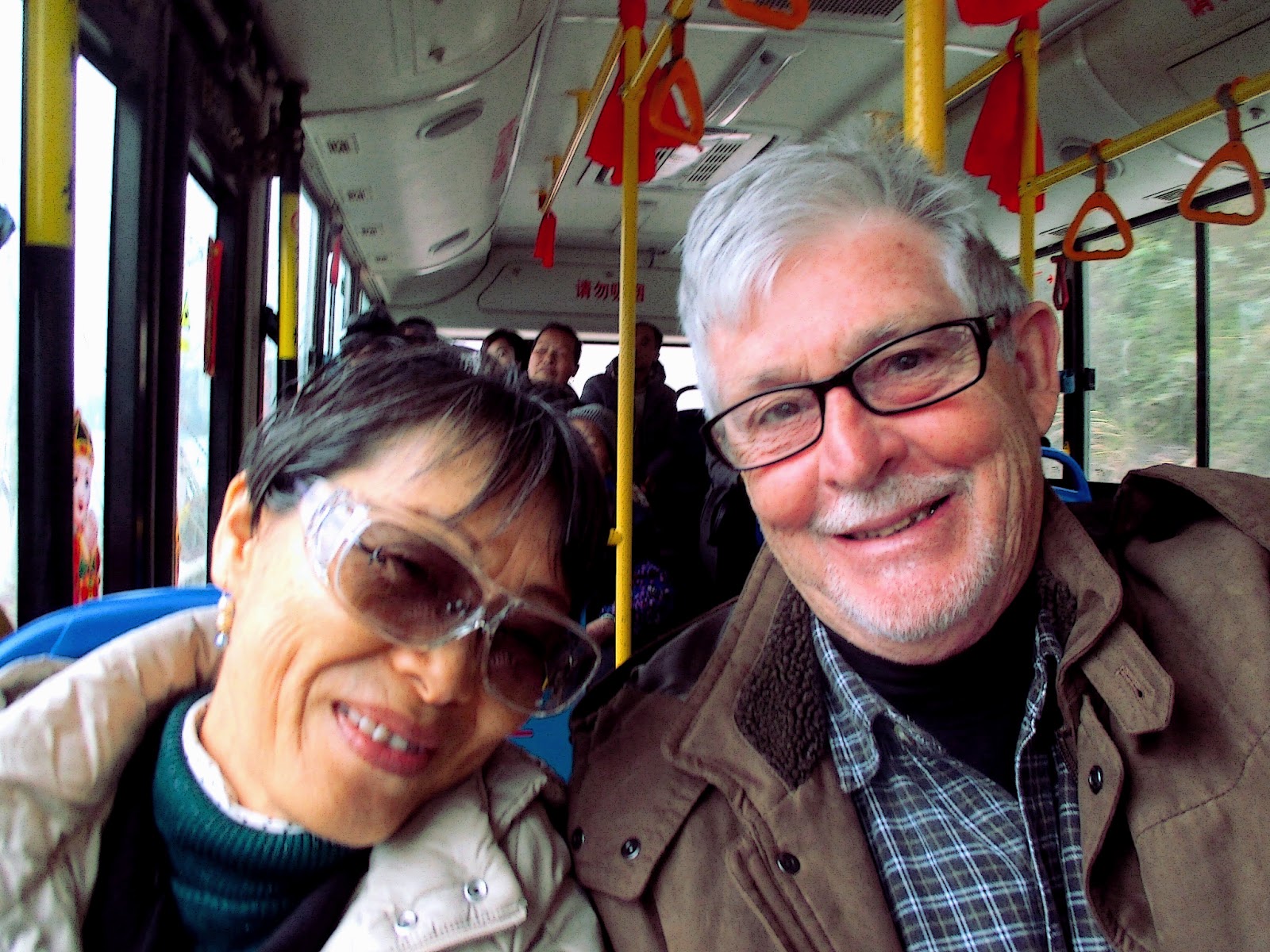
on the bus
      There was actually a bit of blue sky and sunshine after many days of gray skies and intermittently rainy weather when we left the hotel and walked to the bus stop in town across the river. The bus is a local bus and there were many people riding going about their daily business. It took about half an hour to reach Chengyang. The tourist information office had a nice surprise for me. I was able to enter the village for free at the senior citizen rate. You don't have to be a Chinese citizen to qualify for the freebie.


green tea leaves and
yellow rape blossoms
bridge framework
      After entering the town the first thing we saw was green fields of tea and yellow rape blossoms and an old wooden bridge in the background. Very picturesque. Although the first bridge is impressive enough, you round a bend and then the Wind-Rain Bridge comes into view. Although we saw several of these covered wooden bridges, the Wind-Rain Bridge is better maintained and in tip-top condition. It is a foot bridge only. Crossing it leads you to the main town. The town is actually composed of several villages connected by foot paths.

the beautiful Wind-Rain Bridge

more "hundreds of steps"
      Helpful locals oriented us in the direction of the Long Feng Hotel we had booked and we were soon checked into a rather rustic and modest room and ready to explore the town. I wanted to get a bird's eye view of the town which nestles in the bed of the river. After a couple of false starts, a man showed us the proper path that leads up to a pavilion at the viewpoint overlooking the town. I knew I would have to climb but didn't realize that we would have to climb "hundreds of steps". It was my second encounter with "hundreds of steps" after the Yellow Dragon Cave in Wulingyuan a couple weeks earlier.

Good Sports and Great Fun
    After half an hour or more of huffing and puffing we finally reached the pavilion. There were several boys apparently having a picnic below the pavilion so we had some fun with them hallooing and peace signing and snapping a few pictures. The boys were good sports and it was great fun! The bird's eye view of the town was worth the climb. 


the Dong Village of Chengyang


Ha, gotcha!
Hi-ho, it's off to work we go . . . 
       The climb down was much easier, but when we got to the bottom the path was blocked by a bunch of guys struggling to carry a large and heavy piece of equipment for a new building. They were pretty ingenious in devising some rigging and slings to maneuver it around a narrow 90 degree angle in the path. Little by little they worked it around and inched it along until the going was freed up. Hernias anyone!


bamboo water wheel brings water up
from the rive to irrigate rice paddies
women tending the tea plants
      We could hear some kind of commotion in the village square off in the distance as we walked the rest of the way down to the river and crossed back into the town. We strolled around exploring and could hear that the ongoing activities were some kind of festival which, of course, lured us towards the music to see what it was all about. As we were sitting around and being accosted by old women selling souvenirs (one actually playfully punched me in the ribs when I said “No, thank you!” too many times), there was a sudden rush of people to line up. Adults and children were lining up to play games for small prizes—mostly ring toss type games. The enthusiasm for these simple games seemed remarkable to behold. Not a smart phone or video game in sight.

young artist

this bridge is also a souvenir shop


Drum Tower Square - people lined up for ring toss type games


and let the games begin ... 
... and continue


the Long Feng Hotel 
cream and sugar?
      Although the Long Feng Hotel is quite unpretentious, largely a hostel, the dinner was unexpectedly delicious. After dark we went out expecting to find the Wind-Rain Bridge and the Drum Tower in the square lit up in colored lights. Unlike many of the beautiful night scenes we had already witnessed, however, Chengyang was a disappointment, the bridge was dark and only the Drum Tower had a bit of lighting to highlight the roof lines.


Drum Tower Square at night

      Returning to Sanjiang and on to Guilin and the well-known karst mountain landscapes along the Li River tomorrow. 

Wednesday, July 5, 2017

hot spring getaway

Yojokan, Lake Togo, Tottori, Japan

     One of the greatest pleasures in Japan is hot spring bathing. Japan is said to be one of the cleanest countries in the world. Although not 100% true, I have never experienced a neater and cleaner country anywhere (and I have experienced many). That sense of hygiene comes right down to the personal level, the people are hygienically oriented almost to the point of obsession. Bathing is not merely a necessity in Japan, it is one of life's great pleasures. In the home bathtubs are deep enough to submerge the entire body in warm to scalding water for deep relaxation. Quick showers here border on social heresy.


        In the bad old days when common people couldn't afford their own baths, there were (and still are) public baths called sento 銭湯 or communal bath. Many people still enjoy them for the social intimacy from time to time even though they may have a bath at home. Another type of communal bath is the onsen 温泉or hot spring bath. Since Japan is geologically volcanic there are plenty of hot springs all over the country. Many places near hot springs have been developed into onsen machi or hot spring towns which mostly consist of numerous ryokan (inns). Japanese often talk of the virtues of "naked communion" (裸の付き合い hadaka no tsukiai) for breaking down barriers and getting to know people in the relaxed atmosphere of a ryokan with an attached onsen.* Nudity is de rigueur at Japanese hot springs; one is not permitted to enter a hot spring bath,(whether public or private) with clothes on, not even swim wear. Anyone who is shy about public nudity would do well to avoid a Japanese hot spring. If, however, you are OK letting it all hang out, you will experience one of the most relaxing pastimes I can think of.


Yojokan 養生館


Yojokan 養生館
        Road Buddy and I love to get away to a hot spring once in a while for some relaxation and a change of scene. We recently decided to do an overnight trip to a ryokan on the Japan Sea coast about a three-hour drive north of of our home. It's a lovely older inn named Yojokan 養生館 that has several outdoor baths, some, communal, segregated by sex, and others, private, that couples can share. The Yojokan is very reasonably priced with two meals included in the fee. Our room was apparently popular with writers in the 19th and 20th Centuries. One such writer was Lafcadio Hearn, of Greek/Irish parentage, who lived in and wrote about Japan in the 19th Century. He is best known for translating Japanese ghost stories that were told to him by his Japanese wife. The room is a beautiful old style Japanese room with a huge veranda on two sides of the tatami room that look out onto Lake Togo, which is connected by a canal to the Sea of Japan.


The Rotenburo (open air bath)


blue light, available; red, occupied
bath is 2 meters above the ground
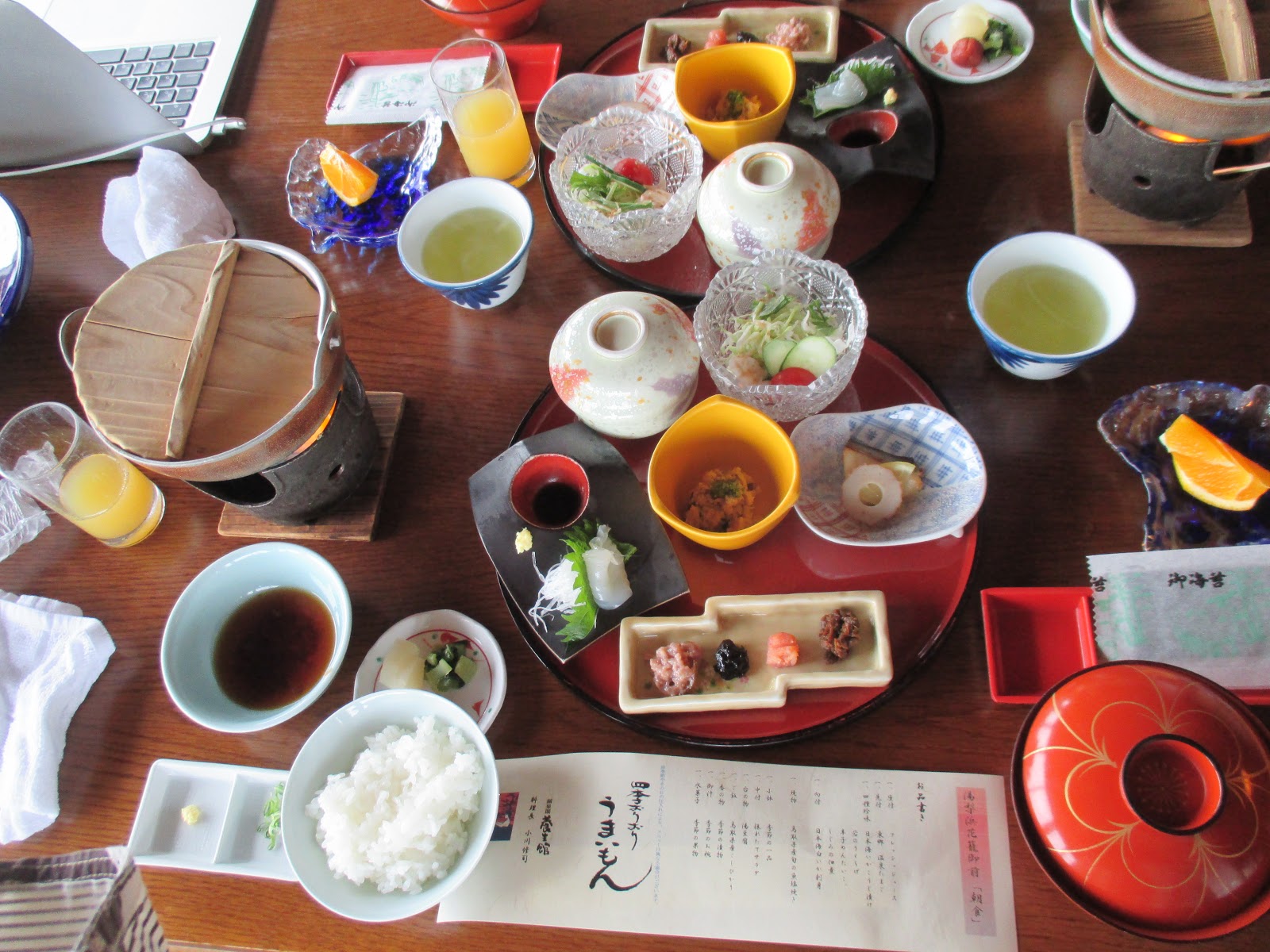
        We arrived around 3 o'clock in the afternoon, had a cup of ocha (green tea) put on our yukata (summer kimono) and went to the small private bath right on the edge of the lake and soaked for an hour or so before dinner. Dinner at a good ryokan is not to be missed although a traditional Japanese gochiso (feast) is best enjoyed when you are accustomed to the Japanese diet since it consists of some very exotic ingredients (from a Western point of view). The presentation is exquisite with amazing attention to detail of colors, textures, odors, serving vessels, etc. Dinner was served by a staff woman clad in traditional kimono on a low table in our room. Later, the table was moved into a corner and the futon (bedding) was laid on the tatami mats for sleeping (after another visit to the bath to aid digestion and relaxation).


Lake Togo and the onsen tub


Gochiso (the Feast)


Daisen

Daisen (not my picture, mountain was covered in cloud due to typhoon)


Daisenji Temple
cheerful breakfast
       After a morning visit to the bath breakfast was served on the veranda before we checked out and headed back home with a detour to Daisen, an extinct volcano, for a little sightseeing at a temple/shrine complex on the slopes of the mountain.

       There was a typhoon in the area that we ran into on a harrowing stressful drive through very heavy rain before we finally and safely pulled into our driveway with nothing more than a bit of tightness in the neck and shoulder muscles.


Ogamiyama Torii
entrance to Ogamiyama Shrine


rough stone footpath


Ogamiyama Shrine


tree that refused to die after being knocked down at Okamiyama Shrine

*Wikipedia article Onsen

Saturday, July 1, 2017

China 2017: 17 – exploring Sanjiang

     I suppose when one thinks of China he thinks of about 1.3 billion people who are all pretty much of the same ethnicity—all Han Chinese. Until my first journey to China, last year, I certainly thought that was the case. In fact there are 56 ethnic groups in China who make up 8.4% of the total population. The rest, 91.6% are Han Chinese. Well, that's a pretty small percentage you might say, but as a percentage of 1.3 billion that makes 109,200,200 people—not much less than the entire population of Japan.

Ethnic Groups lined up on the stage
       In Guilin, we saw a large gathering in the large square visible from our hotel room window. It drew us like a magnet out to the square where there appeared to be some kind of festival going on. It turned out to be a convention of Ethnic Groups from all over China with a multitude of beautiful ethnic costumes and singing and dancing on the stage in front a huge screen with colorful projections as a backdrop.

       At any rate, the reason we came to Sanjiang was to visit, not Sanjiang itself, but a Dong Ethnic Village not far from the city and reachable by local bus. The Dong Village is best known for it bridge architecture, one of which is said to be one of the four most famous bridges in the world. I wonder what the other three are?

our hotel is the pink building in the top left -
the old town is on the upper right 

the market place
guess you have to pluck 'em yourself
      Spent the first day getting oriented to a strange new town. This is usually the most critical activity after arriving in a new town—finding out where the local market and transportation are, where the bank and good restaurants are located . . . and a little walk about to get acquainted with the town and wave, smile and say hello to people in the market. (Road Buddy says I come across as a charmer just because I'm a Caucasian. But I told her I knew that and use it to my advantage. But, I added, I automatically stand out just being Caucasian in a sea of Asians, but being such in itself is not enough to be “charming” ; it takes a personality and a knack for knowing your effect on people. I gave her an example of a certain Caucasian person we know who would not be thought charming—she got the point.)


chicken in the basket
bakery
       We accomplished quite a lot in one day. Miss Liu, the English-speaking staff lady arranged a taxi to take us the Sanjiang high speed railway terminal to pick up our tickets to Guilin. Next we walked into town from the hotel (a 10- or 15-minute walk) to find the bus stop for the local bus to the Dong Village, but we got confused by the building we thought was the bus terminal. We saw a man sitting behind a counter and asked him where the stop for the Dong Village bus was. He understood and kindly came out from behind the counter and almost literally took us by the hand and showed us the way, across the street, to the bus stop, which we duly made a mental note of for the following day.


sign seen in the bakery
        R.B.'s shoes were leaking. We found a shoe store in the market that was teeming with all kinds of shops and sidewalk stalls along the street and she bought a new pair for a very reasonable price. I think the “C” in China stands for Commerce. China is truly a country alive with a vibrant street life of commerce.


old town along the river
viewed from our hotel 
run down houses and
trash strewn environs
       We decided to explore the old town that I had seen across the river from the hotel. Although built right on the river bank like in Fenghuang, the old town looked shabby and decrepit from the hotel window. Part of it turned out to be a bit of a shocker. Old houses were in a sad state of disrepair with much trash strewn about. Yet the old town is not dead, there is laundry hanging on the porches--a sure sign of life within. As you walk up the street the dwellings improve little by little and it becomes apparent that the area is engaged in furniture making as a craft trade and children play badminton in the street.


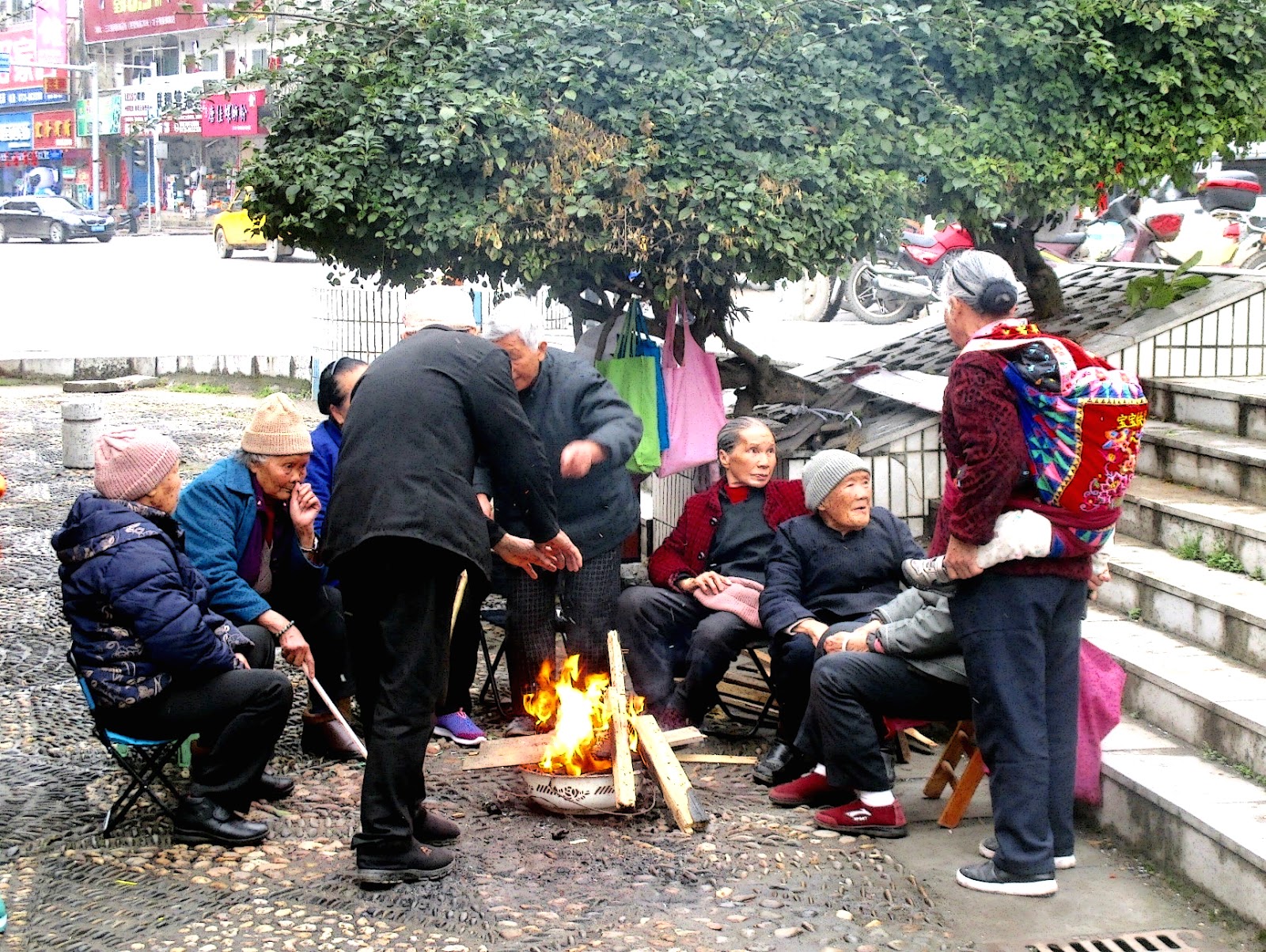
old folks hanging out in the square
old woman tending her
vegetable patch by the river
       Ambled back to the hotel with a few detours here and there absorbing the life of Sanjiang. Towards evening we went out for some beef noodles and dumplings at the same little shop we ate at yesterday. It was dusk when we left the noodle shop and headed back to the hotel. The lights were just coming on in the huge drum tower next door to the hotel and by chance a large group of women dressed in traditional Dong costumes happened to be posing for a photo op. I turned on my “charm offensive” and asked them to line up in front of the tower to pose for me and they happily obliged.


beef noodles and dumplings
in their Ethnic finery


Dong ladies and the drum tower outlined in light

       Going on an overnighter to the Dong Village tomorrow.