Noilly Prattle: Persian Odyssey
Showing posts with label Persian Odyssey. Show all posts

Tuesday, July 3, 2012

Persian Odyssey: Part XIX – the chapter is ended

Gold Culture in Iran


Common sense prevailed and I made up my mind to leave Esfahan as soon as an opportunity of any kind presented itself—even if I had to ride out on a camel. There were rumors of evacuation flights offered by Pan American Airlines coming to take out any people who wanted to leave with the caveat that we would lose any benefits we were entitled to upon completing a full contract. Many people were not willing to lose their benefits or had too much money tied up in their inaccessible bank accounts and chose to stay on, but not a few, including me, decided to chuck it all and signed on to the evacuation flights. I suppose the Embassy had finally decided to face the music.

bazaar after hours
gold shop
We would not be allowed to take any cash out of the country and I had a fair amount of rials in cash. I hit on an idea and got in touch with Sandy (nickname), an Iranian guy who was a friend, and who knew his way around Esfahan. Many shops, including those in the gold bazaar, were closed by now but, according to Sandy, they were doing a back door business and he could get me into one of these jewelry shops. Surreptitiously then, one evening we slipped into the jewelry shop just after dark, literally by the back door, and I bought as many 18 karat gold rings as I could get for my rials. My plan was to thread the rings on a gold chain and hang it around my neck inside my shirt and try to slip it out undetected by the customs officials, should there be any, screening the evacuees.

 Queen Farah Diba in happier times
After many hurdles, the Iranian authorities seemingly cut the red tape and cleared the way for the PanAm flights to land at Esfahan airport in mid-January, 1979. The big day arrived, I said goodbye and fare-thee-well to J., who had decided not to leave, told him there was a pot of chile on the stove, and boarded one of the buses at the base that were to take us to the airport. Then the interminable wait in the terminal for the planes to arrive. Everyone was, understandably, on edge and nervous conversations to the tune of “When are they gonna get here?” abounded. A particularly attractive young woman teacher, M. (looked a little like Farah Diba), a recent arrival in Esfahan, was extremely nervous and frightened and we gravitated to each other and helped  keep up each other's courage—then too, there was an attraction as well. Shelter from the storm!

After several hours of anxiety there was an announcement to the effect that the authorities weren't going to allow the planes to land after all, that they were being held up, if I remember correctly, in Athens. Now, nerves stretched to the breaking point, overwrought, we were told that the Embassy was negotiating and that we would all be bused to a nearby hotel pending further notification. At the hotel people were being assigned rooms and had to double up, so M. and I decided to share a room and help each other get through the night. During the night we vowed that if we ever got out of this we would meet again in some bright future and fair land and live happily ever after. Dreams!

In the morning we were informed that, finally, the PanAm flights would be allowed to land and would be arriving from Athens shortly. This news was greeting with a “Yeah, sure, we'll see!” attitude, but everyone packed up and got ready to board the buses one more time. M. and I stayed close together, unwilling to be separated, so that we could board the same aircraft. I don't think anybody really believed we were going to get out of there until we were actually seated and belted, I with my gold safely tucked into my shirt, and were really taxiing to the runway. The PanAm pilot was pretty chipper as he announced: “We're cleared for takeoff!” The engines roared and I felt the familiar push against the seat back as the great bird accelerated down the tarmac, reached takeoff speed and soared “up the delirious burning blue”. Suddenly, an enormous cheer erupted in the cabin as everyone on board went wild with relief and long suppressed emotions. So ended one of the most remarkable periods in my global wanderings.


up up and away
P.S.:
The Shah was forced to leave Iran and went into exile on January 16, 1979—just a few days after I did, and in the resulting power vacuum two weeks later on February 1, 1979 the Ayatollah Ruhollah Khomeini returned to Tehran to the greeting of millions of Iranians. The rest, as they say, is history.


The End.

Saturday, June 30, 2012

Persian Odyssey: Part XVIII – things fall apart


street demonstrations
Between August and December 1978 strikes and demonstrations increasingly paralyzed the country.

How to describe what amounts to being in a combat zone?

When I was a kid there was a section of Boston's Washington Street and the area around Scollay Square that was often referred to as “the combat zone”. It was an area of bars and strip and clip joints frequented by sailors from the nearby naval base and civilian habitués seeking thrills of various kinds—including barroom brawls, from which the zone's nickname was partly derived. One high school rite of passage in the 1950s for boys was to be able to brag about having seen some T&A at the Old Howard burlesque theater in Scollay Square. But, I digress. Nostalgia, I guess!

Esfahan became, by degrees, something of a combat zone with weapons more deadly than the fisticuffs of Washington Street. Many of the haunts of the expat community and their association with “western corruption”, such as movie houses, restaurants, clubs, discos—even some banks—were attacked with molotov cocktails, homemade bombs and various and sundry incendiary devices. Gunfire and machine gun rat-a-tat-tats could be heard in the streets, especially at night outside of our high walls, making venturing on the streets between sundown and sunrise a risky business.

Abassi Hotel and Shah Mosque dome
Living alone left me feeling insecure. In chaotic situations like this, one seeks the shelter of the tribe in the community cave. The tribe was no longer gathering at the customary newly burnt out shells of our watering holes and the sense of isolation became increasingly stronger especially after business hours. Fortunately, there were some other guys in the teachers' room at the school looking to get together (one of whom was my original roommate J.) and we decided to share a house with a couple other guys owned by a doctor who was sympathetic to the ancien régime and was courageous enough to rent the house to foreigners. This house was not far from the old Abassi Hotel and practically in the shadow of the dome of the Shah Mosque, but also in a central area that was particularly busy with the nighttime fire fights between the rebel Islamist forces and the Shah's soldiers. The rat-a-tat-tats were closing in on us.


darkness in daylight
D. had moved on after our rift and had also moved from our house. I wanted to do a little fence mending and apologize for what had happened. I decided to go and see her one night on foot (I had sold the Yamaha) in spite of the risks. So I put on some dark clothes and a dark woolen cap (trying to look like a local in the dark) and headed for her house. I hadn't known she was with another guy, so I just made polite noises and small talk for a few minutes and excused myself, but D. followed me down the stairs. At the bottom I turned and we hugged each other, I told her that I was sorry for the way things had not worked out and that I had decided to leave Esfahan as soon as possible. She wished me well and said that she wasn't ready to go yet. And so I turned, blended into the shadows, and walked off into the night.


idle Hueys - flight training suspended
A sense of gloom was slowly descending on the teachers' room. The base was now involved in a struggle for its own existence. Training programs languished as did the teaching staff who spent most of our days hanging around and speculating on what the future might bring—should I stay, should I leave? There were incidents of scuffles with the locals and the expats. For example, I shared a cab to go the base one day with several other local people as far as a traffic circle where we would pick up the base bus to go the rest of the way. When the cab reached the stop I was angrily hustled, almost pushed, out of the cab for no apparent reason except that I was a foreigner. I was relieved to see other teachers waiting for the base bus and joined them.


demonstrations became increasingly more violent
Things went from bad to worse. We would get lectures from company supervisors telling us that, according to the Embassy, things were going alright and we should hang in until the rebels were defeated—show support for the Shah. Meanwhile, the banks were shut down and we could no longer get our money out. For some people who had been in Esfahan a long time that was a very serious development since they had considerable sums locked up in Iranian rials. My money was mostly in cash. Still, we kept getting assurances from the Embassy that it was just a matter of time now and things would be back to business as usual. People were agonizing over whether to get out or stay. Surely, some of the more naïve and obtuse ones reasoned, the Embassy must know better than we did how things were developing in the streets and the rest of the country. Then the airport was shut down and it was no longer possible to leave whether you wanted to or not. So much for the Embassy's assurances. This was sometime in December as I remember it.

To be concluded...

Thursday, June 21, 2012

Persian Odyssey: Part XVII – Like a falling stone


desert landscape
We flew over the desert to a training area where the students were put through their paces on various flight procedures and maneuvers. I am glad to be able to report that communication snafus were at a minimum, so much so that I was able to relax enough to enjoy the flight itself and the views of the ever changing landscape below. If you ever saw the flight scene in the film Out of Africa it would give you some idea. I even spotted lots of camels on the desert floor under me. Finally we landed for lunch and a well earned break. There were several camels and locals nearby and my Texas cowboy asked me if I'd like to take a ride on one. Yeah, like you'd even have to ask, right? It was exactly what I was thinking: “Boy, would I love to ride a camel.” A little negotiation and a camel obligingly knelt down and I clambered up onto its hump. The camel stood up and hoisted me up with it and the guy whose camel it was led us around in the desert with me riding high and proud and having the time of my life. 

in my flight suit on the camel
After lunch we went back up, did some more training exercises until it was time to start heading back to the base. Well, I was pretty relaxed and used to flying in the helicopter, the student was flying pretty smoothly as well and there wasn't a lot of talk going on between the two pilots. Suddenly, without warning, the rotor quit and the damned Huey started to fall straight down like a rock, very un-Out of Africa-like, with the desert floor rushing up to meet us. I think I was too stunned to scream. The Texas cowboy sat there calmly observing the near but not quite panicking student who was struggling with the controls. Down we kept on dropping and I figured my time on earth was untimely up.

view from the back se


There wasn't much point in making a scene, so I just tensely awaited the end hoping it would be instantaneous and painless. Suddenly, I felt a jolt and the helicopter stopped falling like a rock and seemed to be falling as if something was cushioning it. The hand of God? The rotor blades were turning again, but I couldn't hear the sound of the engine. Shortly thereafter, the still cool as a cucumber cowboy pushed a button, the engine kicked in again, the Huey stopped falling and continued its normal flight back to the base. I found my voice and shakily asked the cowboy what the hell happened back there? He said: “Oh, that! It's just an emergency procedure for when and if you lose your engine.” “What if the engine hadn't restarted?” I asked. “Well, when the chopper falls like that the air catches in the rotor and starts it spinning and breaks the fall. Theoretically, you could land the helicopter that way, but it's not easy and not too smooth. For training, we restart the engine to make it easier for the student to land.”

“Well, that's nice to know,” I said. Muttering to myself: “You could've told me beforehand.”

And, yes, I went back up a few more times (and lived to tell about it) until the base went into shutdown as the strikes and demonstrations, bombings and fighting in the streets that defined the autumn and winter of 1978 accelerated to their climax.

To be continued...

Sunday, June 17, 2012

Persian Odyssey: Part XVI - Hueys


typical Huey used to train cadets
pilot training
You simply haven't lived until you've gone up into the wild (and I mean wild) blue yonder as an in-flight tutor  in the back seat of a Huey with a “Texas cowboy” instructor pilot who may or may not think the student pilot is “stupid” (but probably does) and where both come from different cultural and linguistic backgrounds. Instead of returning to classroom duties, I requested this in-flight tutor and problem solver assignment because 1) I wanted a change, 2) I had never flown in a helicopter and 3) I thought it would be fun and exciting. The job, plain and simple, was to iron out communication problems in mid flight between these two, on both of whom all our lives depended. And, to be completely honest, I doubt if the Texas cowboys had much confidence in either the student pilots or me. But to give the instructor pilots their due, they were very competent pilots and teachers. The fact that I'm alive today and writing about it is testament to their skill. 

what "rock-a-bye-baby" looks like if you blow it


Helicopter pilot training isn't simply a matter of taking off, cruising and landing. What else, you may ask? Emergency procedures is what else. Remember, Hueys, after all, are not passenger aircraft, they are combat machines—and THAT can lead to any number and type of “emergencies”. One of these is what I came to call, evocatively enough, “rock-a-bye-baby”. Rock-a-bye-baby perhaps shouldn't be classified as an emergency procedure, more like breaking a horse. It may even have been an inside joke, for all I know, on the part of the Texas cowboys to scare the flight suit off both the student and the poor schlep whose gone and gotten him or herself sitting in the back seat. These right stuff he-man types probably thought of English instructors of either sex as she-men.

left/right rocking maneuver
In the rock-a-bye-baby maneuver, with the Huey hovering a mere meter or so above the ground the pilot begins to rock the aircraft back and forth (side to side and front and back) until the rotor blades and nose and tail practically touch the ground. One slight miscalculation and we'd all have been cooked in a great ball of fire. Hearty guffaws and high fives all around and we're off into the lemon yellow blue with the rest of the training squadron. 


medium high flight

Riding in a helicopter and flying over the desert is an experience not to be missed. High Flight, a poem by John Gillespie Magee, Jr,* describes the feeling best: 

Oh! I have slipped the surly bonds of Earth
And danced the skies on laughter-silvered wings;
Sunward I’ve climbed, and joined the tumbling mirth
of sun-split clouds, — and done a hundred things
You have not dreamed of — wheeled and soared and swung
High in the sunlit silence. Hov’ring there,
I’ve chased the shouting wind along, and flung
My eager craft through footless halls of air....

Up, up the long, delirious, burning blue
I’ve topped the wind-swept heights with easy grace.
Where never lark, or even eagle flew —
And, while with silent lifting mind I have trod
The high untrespassed sanctity of space,
- Put out my hand, and touched the face of God.

*Unfortunately, Magee felt the fist of God a short while later and was killed in a mid-air collision in England at 19-years of age.

To be continued...

Sunday, June 10, 2012

Persian Odyssey: Part XV – Flashback


When I returned from my motorcycle journey through Ancient Persia, I came back to an increasingly turbulent present day Iran and the third of the four houses that I rented within the year that I lived in Esfahan. There were no restrictions on where we were allowed to live as foreigners in Iran as was the case later, for example, in Saudi Arabia where foreign workers were required to live in compounds specially designated for foreigners.

The incredible beauty of Esfahan aside, individual homes, in harmony with the city, can also be quite charming. As is characteristic in that desert part of the world Iranian homes are enclosed by relatively high walls, a world unto themselves, with a house and courtyard within. There is often a small fountain and garden in the courtyard and the house opens out onto the courtyard.

J.
Returning from a 2½ -year stint with the Peace Corps in Africa, I got a job with a company based in Chicago that had a contract with Bell Helicopter International to teach English in Esfahan, Iran. I shared my first house with J., a colleague I had met in Chicago at the home office of our company (I've seen it referred to ironically as “Belemedia”). Pretty close to its actual name in fact. J. and I were hired at the same time and we decided to share a house once we arrived in Esfahan. A funny story about him: he was rather phobic about eating local food and would always soak vegetables and fruit purchased from local markets in an anti-bacterial solution (such as bleach and water), but always complained of stomach disorders anyway—the bleach, I wonder? Me, I ate anything I wanted (unsoaked and unbleached) and never even got the hiccups. One of my favorites stops, while off on short bike jaunts, was eating at roadside stands that sold lamb kebab with roasted tomatoes and salads of mixed herbs. Nun (pronounced 'noon') is the most delicious flat-bread I ever tasted. It is baked in kiln-like ovens by slapping the dough on the inside wall and baking it. We would go in the early morning before school to the bakery and buy some, piping hot fresh from the oven, scrape off the ash residue, take it home and eat it immediately with some coffee for breakfast.

D.
I soon met D., a teacher at the school. We were attracted to each other, and after dating and discoing and cycling around the area for a while we decided to get a place together, so we rented what was my second house with all the right characteristics, high wall, courtyard with fountain and garden and a nice house with a great cellar that made a wonderful den. Unfortunately, I felt constrained by domestic bliss; the bloom was soon off the rose and I began going out again—on my own. I then met C., another teacher, at my favorite disco, and she was soon riding pillion on the Yamaha. Naturally, living in a goldfish bowl and frequenting the same haunts as expats usually do, word got around and I came home one night to find the door locked, which led to a ruckus in the neighborhood—shouting match and threats to break the door down, etc. Soon enough, a hunt for another house, this time alone, my third—the one I came back to after returning from my odyssey.

Meanwhile, I had returned to work at the air base, this time as an in-flight tutor to the students who had graduated from the classroom part of their English and pilot training program. Essentially, I rode in the back seat of the UH-1 type Bell helicopters (Hueys) that are synonymous with the Vietnam War and tried to rectify any communication problems between the “Texas cowboys” (many were Vietnam veterans) instructor pilots and the Iranian cadets they were flight training. Hooeee, Huey!

mosque in Nain (famous for carpets) near Esfahan 
relatively unadorned but blends beautifully into the desert around Nain
interior of Nain mosque dome also plain but beautiful

metalwork tray (one of my few remaining mementos)

miniature 7 by 12 cm. (another memento)


To be continued....

Friday, June 1, 2012

Persian Odyssey: Part XIV – Return to Esfahan


Leaving the sites of Persepolis and Pasargad I came to the crossroads where the tomb of Cyrus the Great is located. It just stands there in what I can only call splendid isolation. Unimposing, really, at first sight its sheer simplicity, almost blending with the surrounding desert, gives you the impression that the whole desert constitutes his final resting place. Unconfined to a mere rock face as is the tomb of Darius and others at Naghsh e Rostam, Cyrus's “greatness” seems as vast as the land itself.

Almost literally in the shadow of Cyrus's tomb I checked the drive train of the now considerably lightened Enduro, threw away most of the remaining gear that would no longer be needed for the final push back to Esfahan, turned away and headed west by northwest. The damaged sprocket had survived reasonably intact thanks, I suppose, to the constant attention and TLC I gave it and I no longer worried about making it back to Esfahan. It had come more than three quarters of the distance and would undoubtedly last for the final leg of the journey. I wondered (considering what I had seen in Kermanshah), as I rode along the highway, what I would find when I arrived back in Esfahan at the end of August, 1978 when, in retrospect, strikes and demonstrations began to paralyze the country.

Iranian kebab with roasted tomatoes
salad with various herbs
Superficially, things hadn't changed much in the week or so that I had been away. My third house looked unchanged as I opened the gate and pulled into the courtyard. I was looking forward to a good meal and a bath and sleeping in a real bed, but I let the bike idle while quickly dumping my gear in the courtyard. I was pretty worn out but there was nothing to eat in the house so I decided to go out for some lamb kebab and the green herbs on the side that I loved so much. I was probably not as alert as I should have been and the traffic on one of the main thoroughfares was very heavy. At any rate I hit a guy who was working his way on foot through the stalled bumper to bumper traffic. Being on a bike you can snake through traffic snarls and that was what I was doing when this guy suddenly appeared in front of me. I hit him and spilled right there on the street. 

Next thing I knew I was sitting, dazed, on the sidewalk with a crowd of people all around me. The bike had been righted and appeared not to be seriously damaged. I asked about the man I had plowed into and, although he was nowhere in sight, they insisted that he was not seriously injured either. Nevertheless, they were anxiously urging me to get back on the bike and get out of there. My head was clearing up by now and I could sense the urgency of their entreaties. They were frightened about something. I tried to ask what was bugging them, but my Farsi was totally inadequate. They realized, of course, that I was a foreigner, probably American, and someone managed to speak enough English to let me know that it would be best if I made myself scarce before the police came. I don't know if they were trying to help me or simply didn't want any hassles with the police, but I picked up their nervous vibes and did, in fact, get back on the bike and, a little shakily at first, returned to my house unfed. I locked the gate then took a long hot back and went to bed. I had some trouble getting to sleep even though I was exhausted, with the incident leaving an uneasy foreboding in my mind. 

To be continued...

Monday, May 28, 2012

Persian Odyssey: Part XIII - Persepolis...

Map - Shiraz to Esfahan, Iran


the climax and crowning glory of my journey through ancient Persia and modern Iran.

Shiraz - tomb of Hafez
Wikipedia image
Although I had one or two students from Shiraz in my class I had made no arrangement to visit them in the course of my journey. Time was running short as well and I was due back in Esfahan to start the next leg of my contract. I was scheduled to be an in-flight tutor with the students who had graduated from the classroom part of their training program. More on that later. At any rate, I more or less bypassed Shiraz, which is known in Iran as the “city of poets”, two of whom, Hafiz 14th Century and Saadi 12th and 13th Centuries, have monuments (tombs) there.

panoramic view of Persepolis looking west - Wikipedia image
first impression - double stair to the site
Gate of Nations
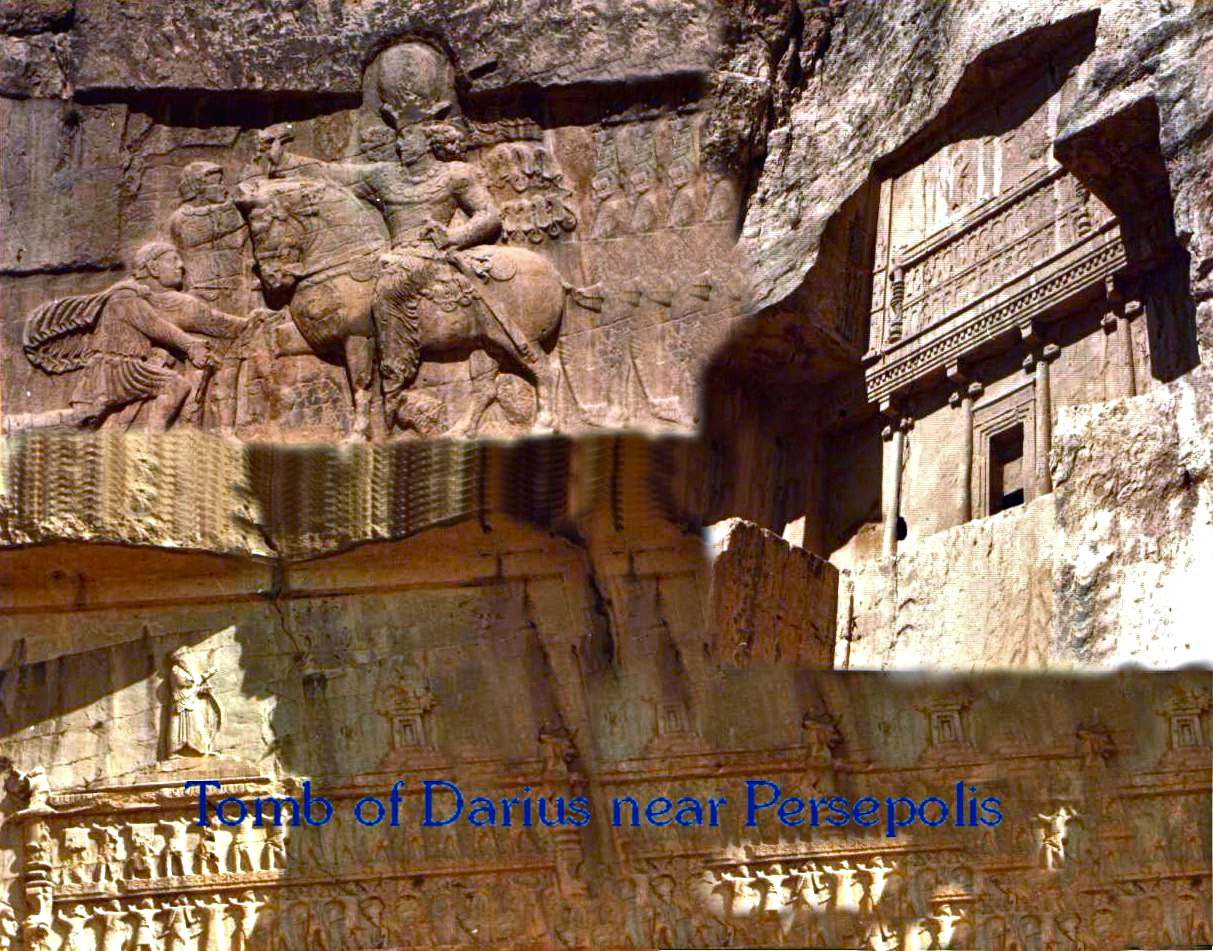
Persepolis turned out to be largely for my eyes only. There was hardly anybody there on the sunny morning I pulled up to the massive double staircase that leads up to the archeological site. I spent the entire day wandering around the site including the nearby sites of Naqsh e Rostam [tomb of Darius and other Achaemenid kings}and Pasargad [palace and tomb of Cyrus the Great], taking photographs until the breathtaking sunset at Persepolis ended a memorable day. I will simply post pictures, some of them my own, some taken from the web to fill in the gaps in what I either lost or failed to record at the time, and let Persepolis speak for itself across a span of some 2500 years. 


Tachar Palace, Wikipedia image
Persian Soldiers, Wikipedia image
lion biting bull, Wikipedia image


Nagsh e Rostam - tomb of Darius the Great

plan of the archeological site
Wikipedia image


Apadana audience hall - Persepolis


Darius and attendants


Pasargad


Soldiers, Wikipedia image


sunset - Tacher palace 


Apadana Palace, Persepolis - sunset


To be continued....

Monday, May 14, 2012

Persian Odyssey: Part XII – a little light historical context

Open desert and oil fields and not much to do but think. How did I come to be here on a semi crippled bike with a civil war postponed and waiting to resume (for me at least) when I returned to Esfahan? Why is the US government, today, hellbent (verbally at least) on kicking Iran's butt? The eternal post-9/11 question: “Why don't they love us?”

Khomeini left (white beard);
Castro right (right)
What do oil and bananas have in common? Big business and big profit—British Petroleum, Exxon Mobile, United Fruit. The flag follows the money. There seems to be a connection with the US's preoccupation with Cuba and its obsession with Iran. It's more than likely a matter of face and pride as well as profits. Both countries, in the persons of Fidel Castro and Ayatollah Ruhollah Khomeini, humiliated the US and drove it out of their countries. And, in between, there was the added insult of the Vietnam War.

We can trace the linear progression of the US involvement with Iran from before the Iranian Revolution to its obsession with Iran's supposed nuclear weapons development program. I believe this latter is simply setting up a straw man, as with Iraq's supposed WMD, as an excuse to manipulate for regime change in Iran to a more pliant government that will let the US have its way as it did when I was working in Esfahan under the Shah in 1978. We could see a repeat performance of the Iraq debacle, but on a much larger and messier scale if the MICC hawks (military-industrial-congressional complex) have their way.

Mossadegh under house arrest
Briefly, then, Mohammad Mossadegh was the democratically elected Prime Minister of Iran from 1951 to 1953. While he was Prime Minister he instituted several social reforms like unemployment compensation, health benefits, etc. He is, however, most famous (or notorious, depending on your point of view) for nationalizing the Iranian oil industry from the Anglo-Persian Oil Company, later known as British Petroleum (BP of recent Gulf of Mexico oil-spill memory). It's not hard to guess what happened next. Mossadegh was ousted in a coup d'etat engineered by Britain's MI5 with the participation of the US's CIA on August 19, 1953. He was arrested, tried and imprisoned for three years and died under house arrest in 1967.

The rest as they say is history. Shah Mohammed Reza Pahlavi was restored to the Peacock Throne and the new Prime Minister, Fazlollah Zahedi's government formed a consortium with foreign oil companies giving “the U.S. and Great Britain the lion's share of Iran's oil wealth.” With the Cold War in the background, the US regained business and military influence in the Shah's Iran. Iran's oil resources were exploited and strong ties between the US and Iranian military forces were forged. Anyone opposed to this arrangement would simply disappear into the dungeons of SAVAK (the Shah's secret police) or go into exile and plot the demise of the Shah.


the Shah (l.) meeting with Alfred Atherton, William Sullivan, Cyrus Vance, President Carter and Zbigniew Brzezinski, 1978


Military hardware was sold and training programs were set up and, voila!, here I was training soldiers as part of the military sales package. My English language training company out of Chicago was sub-contracted to Bell Helicopter International, which was, as I mentioned earlier, training Iranian helicopter pilots in Esfahan. Until the excrement began to hit the fan around mid-1978, soon to culminate in the downfall of the Shah and the American Embassy hostage crisis in Tehran which the US has never forgotten or forgiven the Islamic Republic of Iran for, and which brings me back on the road to Shiraz and a short pit stop before going on to Persepolis.

[All photos in this post courtesy of Wikipedia, which is also responsible for filling in the gaps in my historical memory.]

To be continued...

Saturday, April 28, 2012

Persian Odyssey: Part XI – Zoroastrianism


gas blowoff in Khuzestan 
The city of Ahwaz is in the center of Iran's oil rich province of Khuzestan. As I headed southeast towards Shiraz I entered the region of the oil fields. Seeing the gas flares that blow off from the wells got me to thinking about fire and energy. [By the way, much of the drama that we are witnessing in the Middle East today is, I believe, associated with the planet's hunger for energy. In my own mind, I think of the ongoing conflicts as the “Energy Wars of the 21st Century”. Whether to attempt to gain control of and/or exploit oil resources--as in Iraq and potentially Iran--or build a pipeline across Afghanistan, the conflicts of the area are directly related to the critical need for the fossil fuel--the "black gold"--that drives our modern energy-dependent lifestyle.]

What I really want to do here, though, is segue into the element of fire. In the desert you are constantly conscious of our great ball of fire—the sun. The top banana in our Solar System (yes, Fundies, it doesn't revolve around us) is not necessarily a friendly source of warmth in the desert, it can be a direct threat of heat stroke if everything isn't up to snuff as my bike sprocket wasn't. So fire was my constant companion on this trip, and the gas flares triggered my awareness of it. With fire on my mind, what should I come across just at this time but the ruins of a Zoroastrian fire temple.

Zarathustra holding the sphere
dome of a fire temple in Esfahan, Iran
You may remember my reference, in an earlier post, to the cuneiform inscriptions at Ganj Nameh in Hamadan praising the Zoroastrian deity Ahura Mazda. Zoroastrianism was the religion of Achaemenid Persia. It was founded by a man named Zarathustra most likely sometime around the 11th Century BC.  Fundamentally, he taught that life was a struggle between truth and falsehood. Man should overcome falsehood and find truth through Zarathustra's teachings. Fire and water were used in fire temples for purification rituals during ceremonies. The inner sanctum of the fire temple, accessible only to priests, was a square chamber with four pillars in the corners supporting a domed roof that protected the sacred fire.

my very own fire temple
interior looking in and out
I rode up to the base of the hill upon which the remains of an ancient fire temple stood and climbed to the top. Some care had been taken to preserve what remained of what must have been the inner sanctum—the place of the sacred fire—with a wattle and daub roof--or, more likely but less romantically, corrugated tin. I could almost imagine echoes of the old rituals. But, nothing in the present, no people nor village nor town anywhere in sight, just the silence and emptiness of the surrounding desert.

Climbed back down, checked the tension on the chain. The damaged sprocket didn't look any worse, no broken gear teeth. Put a little more tension on the chain, applied more lubricant (no more signs of my recent close encounter of the unfriendly kind) and continued on southeast towards Shiraz and Persepolis.

PS: Zoroastrianism is still practiced in Iran by a small element of the otherwise mostly Shiite Moslem population. Their main fire temple is in the city of Yazd. There is also a fairly large community of Parsis who practice Zoroastrianism in Mumbai, India.

the modern fire temple in Yazd, Iran
[Photos of Zarathustra, Esfahan and Yazd fire temples courtesy of Wikipedia.]


To be continued...