Noilly Prattle

Monday, August 24, 2015

when you're thrown from a horse . . .

     It's an old saw, but when you are thrown from a horse, folk wisdom dictates that you get right back on . . . to avert an irrational fear of riding again.

...after
     This is not about horses with four legs, but the kind under the hood of a car, a car that was sideswiped in a road accident, my car, and my fault; my attention was distracted and I missed seeing a stop sign—too late to prevent the car coming at us from the passenger side from hurtling into us. The sickening sound of such an impact is impossible to describe and the instinct, as the car fills with smoke, screams to get out as quickly as possible.

     Then you see the shambles that was your beautiful automobile sitting forlornly in the middle of the road. The car seems to be in shock as much as you are. The rest is waiting for the ambulance, the police, the fire trucks; it's the incessant noise of endless questions; it's the buzzing in your head that says: “We are fucked!”--1300 miles from home and now no wheels and travel plans in shreds.

before....
      This is not about being thrown from the horse, but about getting back on again, if not this horse, then, for a while, other ones. Our mare, a Mazda Demio 1.3 liter (we nicknamed her “Demi” because the GPS speaks with a patient and polite female voice), can be repaired and restored to its pre-collision condition we were assured by the repair shop owner, and she will be shipped back to our home in a month or two.

     Our son arrived on time at the airport, where we were supposed to meet him, soon after the accident. We called and asked him to take a taxi to the hospital that was treating Road Buddy for her non-life threatening injuries. I myself appeared to be unhurt (I felt a soreness in my chest later on where the seat belt had restrained me). I waited for him in the lobby and explained the situation. He was calm and supportive. The police required me to stay in town until they determined whether there would be a personal injury claim against me so we had to stay in a hotel in town. Since Road Buddy (our Japanese speaker) was being examined our son called the hotel and calmly and efficiently made arrangements since my Japanese isn't good enough to handle complex issues on a phone.

our rented Nissan K-car
     After all the examinations and questions were settled we took a taxi to the hotel. The next morning, the police called and said that no personal injury charges would be filed against me, I wouldn't lose my driver's license, and we were free to leave town, he said. We decided to continue the next few days of our planned trip with our son in a rented car. We had to stop off at the repair shop to make arrangements for the Mazda and planned to rent a car near the hotel. We walked out in the rain and checked the rental agencies, but not one of them had a car available. Blocked on that front, we took a taxi to the repair shop. We got a very positive feeling from the owner who assured us that the car was not as bad as I had thought and could be repaired—at a cost of at least $4000...all covered by insurance. We were more than a little relieved. On an off chance we asked the shop people if they could loan us a replacement vehicle for a few days. They said they could arrange a rented car from the airport (they apparently had a connection—it's nice to know people).
   
     In due time a light blue K-car (650 cc) arrived, we transferred what gear we had left in the navy blue Mazda and, a little shakily at first, I got behind the wheel and we drove off, a trifle over-cautiously at first, on the next leg of our planned trip, a couple days in the Shiretoko Peninsula region of eastern Hokkaido—in the deep north of Japan. Japan's irredenta, the Northern Islands, lie just off the coast of eastern Hokkaido. They have been occupied by Russia since the end of World War II and remain a bone of contention between the two nations. 

Shiretoko Peninsula in winter with Sea of Okhotsk soft ice flow


Saturday, August 15, 2015

On the road to the deep north -- Hieizan (比叡山)

Amida Hall
      Japan has a unique history in terms of religious development. Unlike the religious wars in Europe between Islam and Christianity, clashes of religion did not occur in Japan between the native animistic Shinto and Buddhism, but rather a sort of peaceful merging or amalgamation of religious beliefs and practices evolved into the present day syncretic culture of Shinto and Buddhism. That is not to say that there have not been religious conflicts, but they tended to be among different interpretations of Buddhist texts and doctrinal differences not unlike the internecine wars between Catholics and Protestants in Europe over similar differences. Of course, political considerations were never very far from religious motives 

Kyoto in summer haze from Hiei-zan
        Travel destinations in Japan almost inevitably include the many temples and shrines one can find all over the country from the famous ones to obscure local ones crumbling away into disuse and ruin as rural depopulation takes the young away from the countryside. Accordingly our winding road trip to the deep north took us to several temple/shrine complexes, where it can be difficult to distinguish where a shrine ends and a temple begins the syncretism is so seamless and well established. Our first stop was the Hiei-zan complex between Kyoto and Lake Biwa.


Main Temple
Saicho
        Enryaku-ji Temple (延暦寺) was founded by a monk named Saicho who went to China in the 8th Century to study Tiantai Buddhism (Tendai in Japanese) and returned to Japan and established a Tendai branch temple on Mount Hiei in 788. The temple complex was razed by fire by a warlord named Oda Nobunaga in 1571 to check the rising power of Tendai warrior monks. After the Tokugawa clan consolidated power and established the Edo Period Shogunate in 1603, they rebuilt the Hiei-zan temple complex and it is still the mother temple of the Tendai sect today.


courtyard of the Main Temple
young monks' work is never done it seems


monks if the Tendai Buddhist sect


Benkei no Ninaidō (with a bridge between
the two temple buildings)
the powerful Benkei pulling a heavy temple bell

        The most charming building on the complex (I thought) was called the “Benkei no Ninaidō” (Benkei holding up the temple bridge). Benkei was a Tendai warrior monk. There is a well known story about Benkei related to a fratricide, again over a power struggle, between two brothers named Yoshitsune and Yoritomo. Benkei is said to have been an unusually big and strong man who was loyal to the heroic warrior Yoshitsune. Yoshitsune was used by his clever scheming brother Yoritomo to fight the clan's battles and then had him pursued to Chūson-ji (a temple we later visited) and forced him to commit seppuku to preempt a power struggle, while his loyal retainer Benkei stood guard at the temple door to preserve the sanctity of the ritual suicide and was pierced by arrows and killed à la St. Sebastian by Yoritomo's hit men. In spite of the fraternal blood on his hands, Yoritomo was victorious over his rival warlords and founded the Kamakura Bakufu (Shogunate) system of government in Japan in 1196. This system was continued by the Tokugawa clan to rule Japan from 1603 to 1868--the Tokugawa Bakufu (Shogunate) of the Edo Period. 

portico capturing the evening sun's glow

legend says that Benkei held up this (broken) bridge
 so that other monks could cross to their prayers


cleanliness is next to godliness I suppose


looking a bit the worse for wear after a long day of driving
and walking around the Hiei-zan complex 


Friday, August 14, 2015

Attending to some unexpected business

      Returning to Niseko from a day trip to Lake Toya in Hokkaido we decided to stop for some ice cream and heard this godawful bang under the car as we pulled into the parking lot. When I stopped to look I noticed that there was a long grate covering a drainage ditch across the lot entrance. One of grates was loose and bent and must have struck the undercarriage of the car as I, unawares, drove over it. A casual inspection showed nothing damaged on the outside of the car, but the sound clearly had come from under the car which we could not see very well. Thoughts of ice cream vanished and we returned to our hotel to phone our insurance company.

       The insurance person was very helpful and arranged for us to take the car to a local mechanic to inspect the undercarriage. The next morning (today) we checked the area under the car for any sign of leakage (none) and the warning light panel (nothing unusual) and drove off to the mechanic's shop about six kilometers away. Using our trusty GPS navigator (whom we have nicknamed Demi—she uses a very patient woman's voice) we quickly found the garage and the mechanic looked at the car right away. He drove the car over a pit built into the floor to have a look at the undercarriage of the car.

        He found nothing wrong, to our great relief, except for a few scratches under the front bumper and under the rocker panel on the driver's side. Since they aren't obvious to the naked eye, we can just buy some touch up paint when we get back home and do a bit of DIY repair work. Since no major repair was necessary we had the pay ¥3000 (about $25) out of pocket, a fee well worth it for the peace of mind of driving so far away from home base.

       The Demio (you can see where the nickname comes from) was really filthy after so many days on the road so we decided to look for a car wash. I didn't want to use one of those automatic machines with the rotating brushes for fear of scratching the paint, so we asked the mechanic if he knew of a car wash where you could wash your car by hand. Happily there was one about one kilometer away, so we drove there and gave Demi a thorough bath inside and out.


       Of course, almost as soon as we pulled out of the car wash it started to rain. But, at least, we got rid of most of the caked up dirt. Did you ever notice how a car seems to run more smoothly right after you wash it? Purely psychological I'm sure, but on which side, yours or the car's, I'm not so sure.

       After all the anxiety over the condition of our Demi and the hard labor involved in scrubbing her down, we decided to chill and relax in a secluded outdoor spa up in the mountains to the northeast of our hotel in Niseko. Ahhhhhhhhhhh!


Thursday, August 13, 2015

Minami Sanriku

explosion and fire a Fukushima Daiichi nuclear plant
March 11, 2011 [Wikipedia]
        We decided to take a road trip to the deep north of Japan, the island of Hokkaido. We planned on a series of seven stops spaced out more or less evenly before boarding a ferry for Hakodate in Hokkaido. Our route took us through the Tohoku region in the northern part of the main island of Honshu. Many may remember that this area was hit by a massive earthquake and tsunami that destroyed many coastal communities on March 11, 2011, a little over four years ago. The same event also hit the nuclear power plant in Fukushima and caused a major catastrophe and meltdown of several reactors. The plant continues to leak radiation into the soil, groundwater and the Pacific Ocean. The plant is estimated to take some 40 years to cool down enough to close and bury the facility.


Matsushima
tsunami memorial
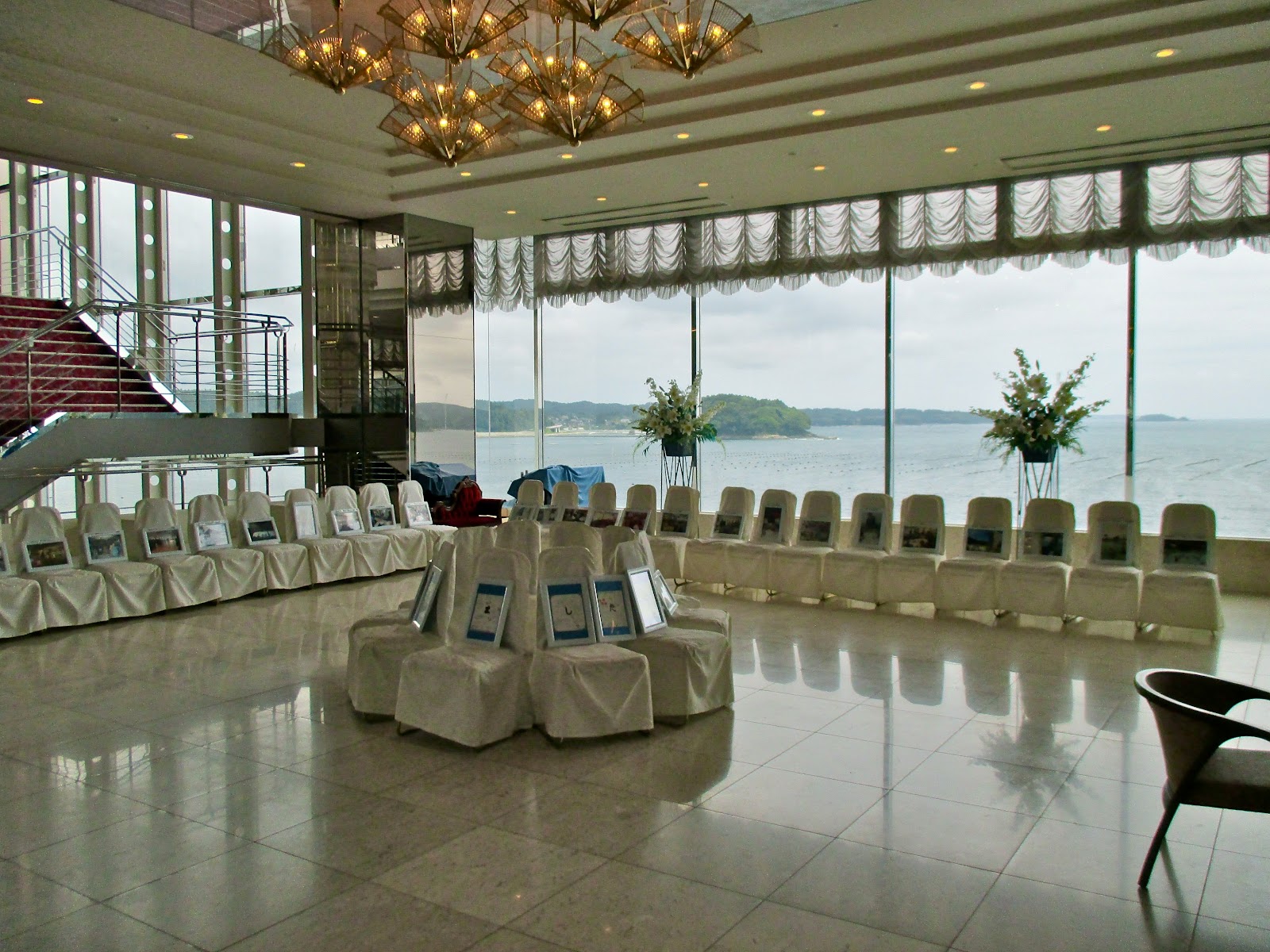
      One of Japan's famous natural beauty spots is the bay of Matsushima and we had planned to stop off there for one night. But then I remembered that the tsunami devastated town of Minami Sanriku was not far from Matsushima and I suggested staying there instead to see how the town looked after four years. It turned out that there was a hot spring hotel in the town (Minami Sanriku Kanyo Hotel) that had escaped most of the tsunami because of its elevated location. We learned while staying there that the hotel had served as a refugee center for many of the tsunami survivors from Minami Sanriku. There is a memorial room set up in lobby consisting of several white chairs with photographs taken during the crisis. Walking along and looking at the photographs is quite a moving experience. You can also get a very good view of the town from the huge hotel windows on the north end of the lobby. There is no longer a habitable town there, only large mounds of sand where people's homes and businesses used to be. 


what used to be the town of Minami Sanriku


Minami Sanriku Kanyo Hotel - post tsunami [Wikipedia]
sculpture made of debris from
Minami Sanriku tsunami strike


      After checking out of the hotel we drove around in the town. There is a lot of work going on that seems to consist mostly of building up huge sand dunes. There doesn't appear to be any rebuilding of homes of businesses. The only commercial activity we saw was a 7 Eleven convenience store and a makeshift gas station near a couple of the damaged buildings that are still standing. It is hard to imagine any kind of community thriving here for a long time if ever again.   

      I thought it would be interesting to compare some Wikipedia photographs taken during and after the tsunami with a few shots I took while driving around the construction areas. 
remarkable shot of the scene on the left as the
tsunami was surging into the town

Minami Sanriku before March 11,  2011


dazed survivors wandering through the ruins


The roof of this building was a designated safe haven, but it proved insufficiently high. Around ten people managed to cling to life there, but twenty others were swept away. 
the same building is still standing today
another damaged building still standing -
sign says Danger Keep Out


the immediate aftermath of the tsunami wave - said to have been as high as 20 meters (65 ft.)
they seem to be covering everything with mounds of sand


still removing debris after 4 years
trucks and heavy machinery everywhere


       These were the only signs of business activity we saw.


7 Eleven convenience store
Eneos gasoline pump


      And a poignant reminder of the inevitability of life even in the face of natural disasters.

man fishing in a stream that was once
30 ft. underwater - life goes on